Worldbuilding
Is there any kind of narrative or worldbuilding that these characters inhabit?
It’s up to the researchers to make up an Iconoplasm story that makes sense in the context of their research interest. To a researcher of the circulatory system, the characters may be living in lotus petals by the river. To a developmental biologist, they may be crew in generation spaceships. To an oncologist, they may be isolated within bubble universes, engaged in multiversal acausal trade.
However, as guidance, I can suggest some constraints.
- In humans, a protein is about 1/10,000 as wide as a cell. Intuitively, that is like a 1.5 m-tall person living in a large city 15 km wide, somewhere between Paris and Moscow in size.
- That said, sometimes you can ignore these numbers on purpose and end up with a more consistent story.
- The cell gets unnecessarily crowded if you try to represent each copy of the protein molecule with its own character. For me, two different narrative approaches both make sense:
- Make each character into a sort of “patron deity” of the gene’s molecular function. This way, it makes sense to let a character’s presence grow with how strongly the gene is expressed. Highly expressed genes can be represented by very powerful characters, barely expressed genes are weak and losing their powers.
- Alternatively, a character’s story can represent one protein molecule’s “playthrough” from ribosome to proteasome. An author can tell two stories about a protein participating in two different “runs” (run 1: translation->some pathway->degradation, run2: translation->some other pathway->degradation). During each run, protein’s memory is stored as post-translational modifications. However, the memories don’t carry over from one run to the next: each time the protein is translated anew, it has no memory of what happened in the “last run”.
- In almost all diagrams of cell biology, the cytoplasm sits below the cell membrane and the extracellular space above it. This orientation makes sense from the perspective of a researcher who looks at the cell from the outside and from above. But for a character living inside the cell, I find a different orientation helpful: being a protein in the cell membrane feels like being an ice fisher. The cell membrane is what you walk on, the extracellular space is below the fisher (down the hole), and the cell nucleus is above the fisher’s head (obscured and faint like the sun behind clouds). In that sense, having a transmembrane domain is like being pulled down by gravity.
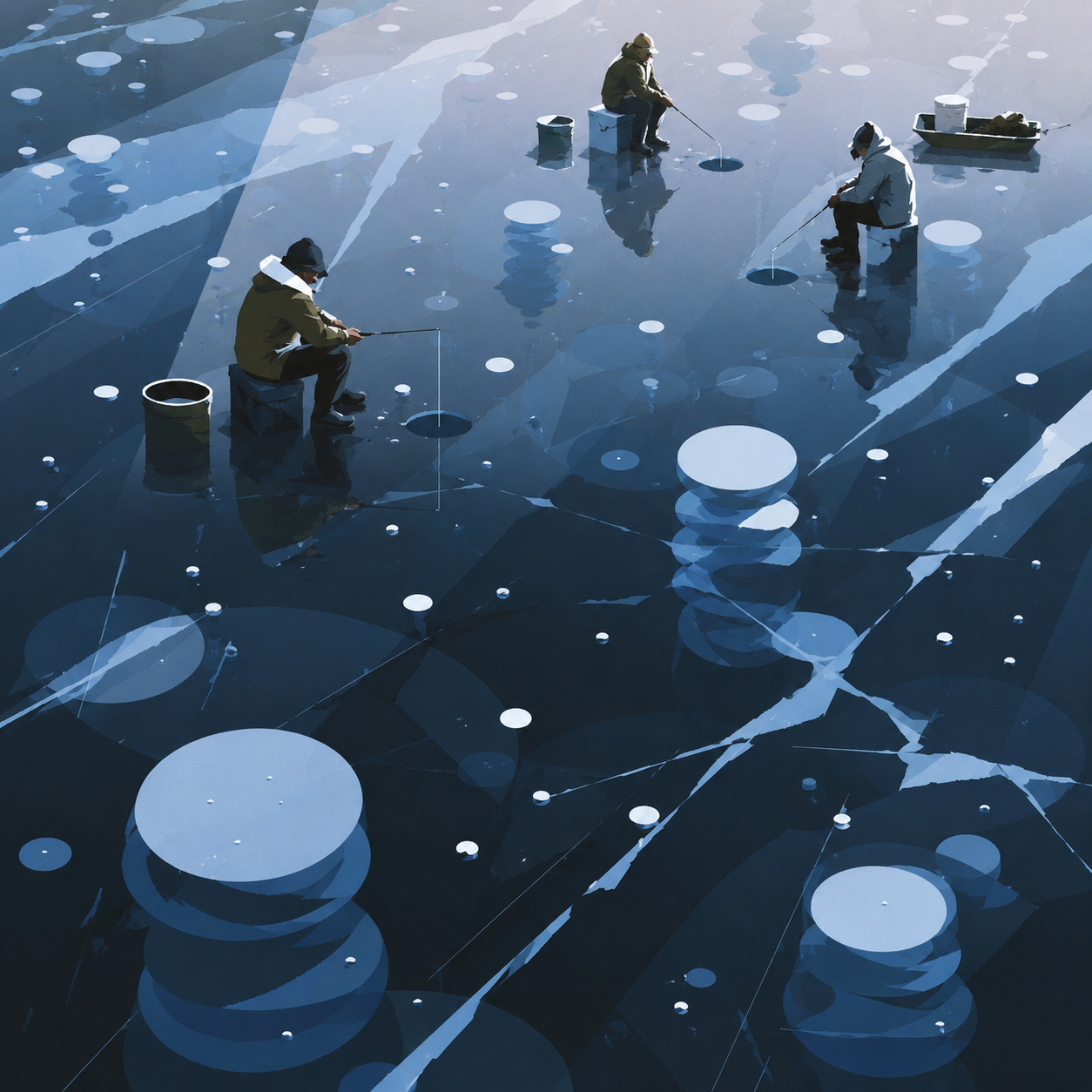
- As humans, we can see what’s far ahead on the horizon. However, most Iconoplasm characters have very limited information about what’s happening elsewhere in the cell. For example, a perinuclear protein can’t see the cell membrane being ruptured from far away - word of it has to travel through messengers and rumor networks, or arrive as a vague directional smell. Picture a dense mist or blur covering the world, or a dense thicket of infrastructure that blocks the view. Alternatively, any far-away horizons that you see on Iconoplasm images might be local illusions or holograms.
- Information about what’s outside the cell membrane is even less accessible. Most characters can’t know for sure if they’re part of some grand design like a multicellular body - only proteins in the outer membrane are even directly aware that there are other cells below them. Genes should follow any “developmental plan” more as a ritual or a compulsion than as a rational design, and there’s probably lots of doubt and suspicion when characters use grand organismal narratives to justify drastic action against their cell-mates.
- Every somatic cell had to first spend an immense amount of time as an immortal germline. The cell became somatic only in the most recent cell divisions (starting from the current body’s embryogenesis). So the somatic cell’s inhabitants should probably treat the situation as unfamiliar or alarming.
- DNA is best represented as the place where the characters keep their immaterial souls: gravestones, phylacteries, vinyl records, scrolls. To get rid of a character for good, you have to destroy the place where its soul is kept; otherwise there’s always a risk that the character will come back from the dead.
- RNAs could be thought of as transient ghost-like spirits that can affect the world only in limited ways. Ribosomes would be the shrine where these spirits incarnate into a material shell. The time before ribosomes existed is covered in mystery - perhaps the rumors of the ancient world of songs upon songs.
- What’s the motivation to initiate mitosis? There are factions that are pro- and anti-mitosis, with their own motivations and narratives. Sometimes, one side wins, sometimes, the other. The organismal consequences of this decision are hard for characters to confidently trace: could be normal development, regeneration, aging, or cancer.
Any ideas for scenarios to explore from inside the cell?
Some scenarios that I would find engaging to explore in an Iconoplasm world:
- Enucleation of an erythrocyte.
- Oncogene-induced apoptosis.
- Living next to a senescent cell and its SASP.
- Sperm-egg fusion (of different species?)
- Leukocyte migration.
- Long-term intracellular parasitism (Malaria hypnozoites).
- Restriction of potency in cell lineages during early development.
- Being assigned the role of a transit-amplifying cell.
- Immortalization or transdifferentiation with OSKM.
- Cell in a body that just died of a heart attack.